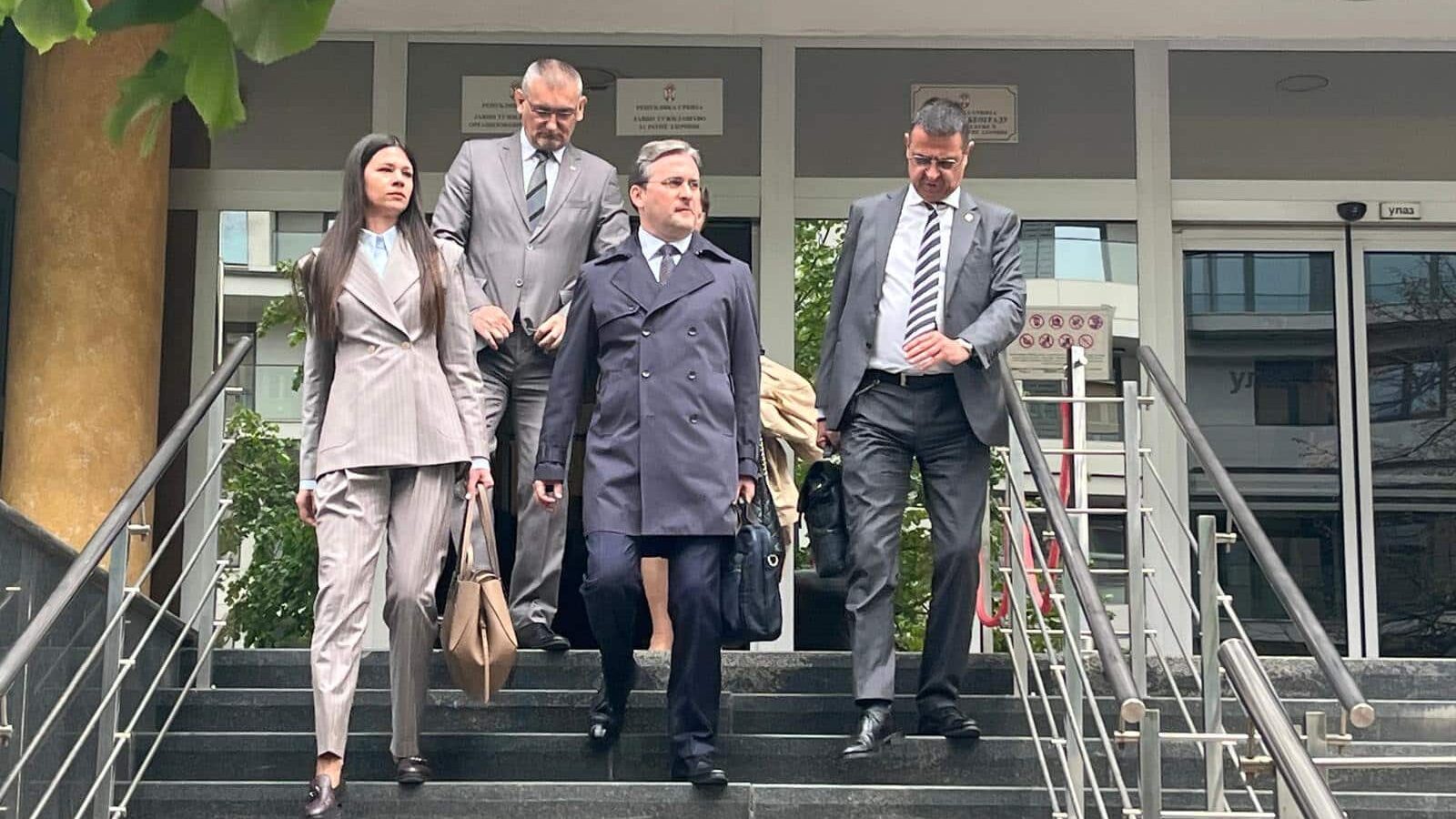
Serbian Minister of Culture Nikola Selakovic appeared in court on Wednesday with three others to face charges that they illegally removed the cultural heritage status of the old Yugoslav Army headquarters in order to pave the way for its demolition and redevelopment. The site has been in disuse since it was bombed by NATO in 1999.
The other defendants are the secretary of the Ministry of Culture, Slavica Jelaca, the acting director of the Institute for the Protection of Cultural Monuments of Serbia, Goran Vasic, and the acting director of the Belgrade City Institute for the Protection of Cultural Monuments, Aleksandar Ivanovic. All have pleaded not guilty.
The defendants are charged with abuse of their official positions, while Selakovic, Jelaca, and Vasic are indicted for forgery of an official document and Ivanovic for abetting forgery.
Selakovic said that he never did anything unlawful. “I never ordered, instructed, pressured anyone, nor did I do anything illegal,” hesaid in court.
The lifting of the former army HQ’s status as a cultural asset was needed to allow for its demolition and make way for a new Trump-style development project The project was linked to the Affinity Partners investment firm owned by Jared Kushner, President Donald Trump’s son-in-law. According to the Wall Street Journal, Kushner gave up on the plan after the indictment of Selakovic and due to the protests against the project.
Selakovic refused to answer the prosecutor’s questions, but did answer questions from the panel of judges. He said in court that he couldn’t remember the meetings or the proposals for removing the building’s cultural heritage status that the indictment mentions.
Selakovic claimed that the proceedings against him and his associates are politically motivated and aimed at “undermining and weakening the highest state authority, creating internal instability, and enabling a political change of government outside legal and constitutional procedures.”
The minister, in his defence, said little about the specific allegations in the indictment, but claimed that there was no abuse of official position in their actions because they did not secure any benefit for anyone, nor did they cause damage to the state.
He added that he did everything because he “saw a great opportunity for our country and our citizens”.
“We had no benefit from it. Only Serbia and its citizens could have benefited,” he said.
In February, when the trial was opened, Prosecutor Vojislav Isailovic said the four defendants had “caused damage to the cultural heritage of the Republic of Serbia”.
In court, Selakovic called the army HQ “ruins”, saying that he was afraid “that parts could fall and injure or kill somebody”. In his defence, he said that the laws in Serbia related to cultural heritage and removing cultural protection are “confused and contradictory”.
Selakovic mostly spoke about the alleged corrupt dealings of the former director of the Institute for the Protection of Cultural Monuments of Serbia, Dubravka Djukanovic, who refused to remove cultural protection from the army HQ site. According to Selakovic and his defence lawyer, Djukanovic will be one of the most important witnesses for the prosecution in the further course of the trial.
Selakovic also spoke negatively about certain prosecutors from the Prosecutor’s Office for Organised Crime, which indicted him. He claimed they are politically motivated and that some of them had participated in the anti-government protests that have been taking place in Serbia for more than 15 months.
“Biased conduct by the prosecution is no longer an assumption, but the most blatant fact,” Selakovic said, calling the Special Prosecutor’s Office for Organised Crime “a rogue state institution” and “organised criminal gang”.
The trial of Selakovic was launched amid growing concerns about government pressure on the judiciary, particularly the Special Prosecutor’s Office for Organised Crime.
Although Selakovic, as part of the Serbian government, has the right to immunity from criminal proceedings for actions performed in the course of his duties, defence lawyer Vladimir Djukanovic stated that “no one will invoke immunity”.
In November 2025, the Serbian Assembly adopted a “lex specialis” to annul the former Yugoslav Army HQ’s cultural heritage status, which dated back to 2005, in order to speed up the redevelopment of the site.
After Wednesday’s hearing, Djukanovic said that he “doesn’t understand at all what there is left to discuss when a special law has been adopted” that nullifies all decisions granting cultural heritage protection status: “Those acts are no longer valid, so it is not clear to me why the court is still dealing with it.”
Selakovic is the first minister in Serbia in 25 years to go on trial while still in office.
He is a veteran member of the ruling Serbian Progressive Party, and a senior state official since the party came to power in 2012. He has served as the justice minister, secretary general of the president’s office, foreign minister, and labour minister before becoming culture minister in 2024.
According to case files seen by BIRN, Ivanovic told the prosecutor’s office that he denies committing any crime but gave in to pressure from Selakovic to issue a draft decision on revoking the cultural heritage status of the old army HQ, even though he did not have the authority to do so.
Jelaca told the prosecutor’s office she had never knowingly done anything unlawful. Vasic admitted his role in the affair in May.
The Institute for the Protection of Cultural Monuments of Serbia has yet to delete the former army HQ from its register of protected cultural monuments.