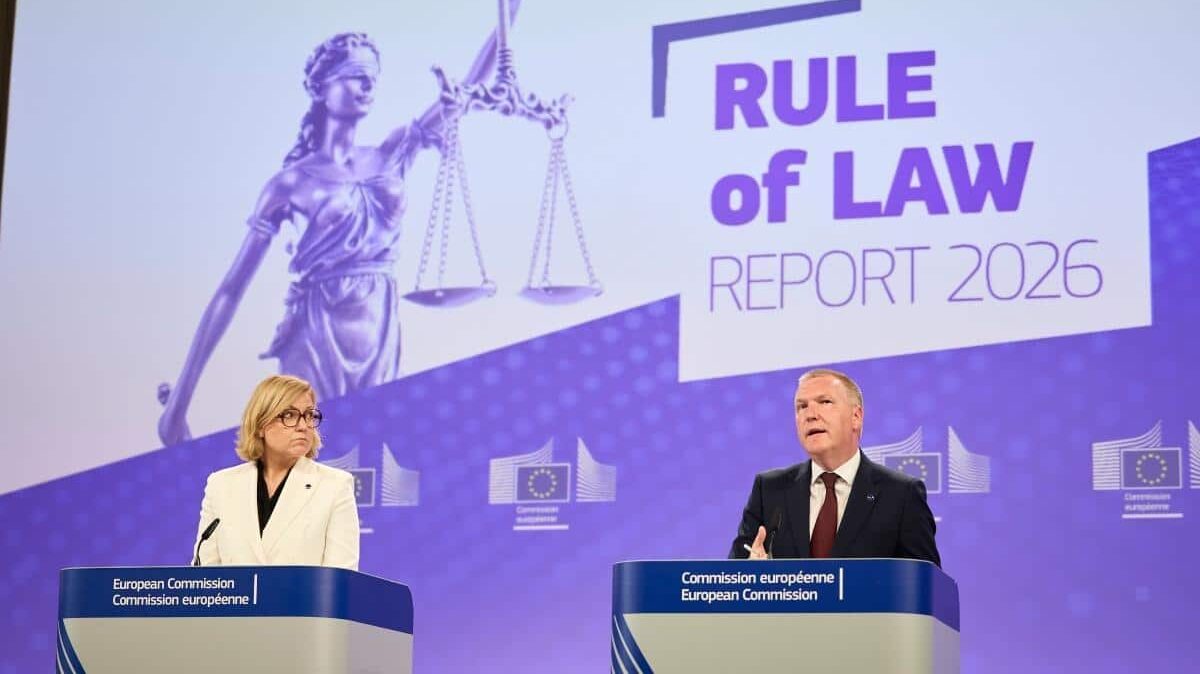
The European Fee’s seventh annual “Rule of Law Document”, printed on Friday, highlighted traits which level to a “broadly distinct trajectory”, even though that progress is uneven, reforms are slack and challenges persist.
The EU govt’s 2026 portray – which appears at the 27 EU member states and the four candidate nations of Albania, Montenegro, North Macedonia and Serbia – effectively-known marked enhancements and foremost reforms performed or underway in all four areas monitored and graded: judicial independence, anti-corruption safeguards, media freedom, and key institutional tests and balances.
The portray – first launched in 2020 in response to deteriorating rule-of-law scenarios in loads of member states, most particularly these in Central and Eastern Europe – also assesses the progress made by member states on imposing the recommendations within the old 365 days’s portray. The 2026 portray stumbled on that 47 per cent of its recommendations had been followed up, either entirely or partially, which compares with 57 per cent the old 365 days.
“This 365 days’s portray confirms a broadly distinct trajectory with some foremost reforms performed or in progress. With regards to one in two of the recommendations made in 2025 has since been addressed either entirely or partially. No doubt, some advice may possibly steal longer to address attributable to legislative or electoral cycles and a few of them are, certainly, advanced, so the image stays uneven across member states, with some challenges persisting in locations,” European Commissioner Michael McGrath informed a press conference.
By system of example, McGrath cited a reform in Bulgaria combating political have an effect on within the Supreme Judicial Council used to be adopted final 365 days; new guidelines in Hungary that hang increased transparency and created tools to battle corruption; and in Romania, new guidelines on lobbying for members of parliament had been launched.
Taking a inquire at the first pillar, judicial independence, the portray highlighted how the level of perceived independence by the public stays particularly low in Croatia and Bulgaria (below 30 per cent), moreover within the expansion nations.
In a few nations love Slovakia and North Macedonia, shortcomings in battling corruption persist, it mentioned. In Hungary, no steps had been taken but to undertake complete legislation on lobbying MPs and revolving doorways, exemplified by the news that the faded minister of international affairs and trade, Peter Szijjarto, will join the Chinese carmaker BYD, even though he used to be a key participant in providing handouts to that company for investments it revamped the past decade.
Taking a inquire at the media panorama, whereas NGOs hang expressed rising considerations about the mutter of media freedom, the portray mentioned the overall challenge within the EU stays “broadly distinct”. It highlighted how, since the newsletter of the 2025 portray, legislation to particularly take care of the enviornment of mutter selling has been adopted in Croatia, Slovakia, Greece and Slovenia, whereas draft legislation to control the matter is in preparation in Bulgaria and Czechia. Transparency and fairness within the distribution of mutter selling to media retail outlets, a particular enviornment for the length of the time Viktor Orban used to be in vitality, has no longer but been addressed in Hungary.
Institutional tests are of particular anguish in Slovakia, the attach distinct amendments to the structure adopted in September 2025 are elevating worries related to the precept of the primacy of EU law.